Journaling Prompts For When You Cannot Remember What You Actually Like
You are standing in a restaurant with a menu in your hands and you have no idea what you want.
Not because the food looks bad. Because somewhere in the last fifteen years you stopped having a position on anything, and now the waiter is looking at you and the honest answer is "I do not mind, you choose."
That is the thing nobody warns you about. No breakdown, no crisis, no moment where it all goes wrong. You just slowly outsource every preference you have until you cannot answer a simple question about your own life.
I wrote a book about getting out of that. You do not need it to start. You need better questions than the ones you have been asking.
Why most journaling prompts do not work
Open any list of journal prompts and you will find some version of this:
What are you grateful for today?
Describe your ideal life in five years.
What does your inner child need to hear?
They are not bad questions. They are just too big, and they are aimed at someone who already knows what she thinks.
If you have spent years muting yourself, "describe your ideal life" is not a prompt. It is an exam you will fail. You will write something vague about being happy and having more time, and you will close the notebook feeling worse than when you opened it.
The prompts that work are annoyingly small. They ask about today. They ask about something that already happened, so there is a real answer sitting there waiting to be noticed rather than invented.
The four phases these move you through
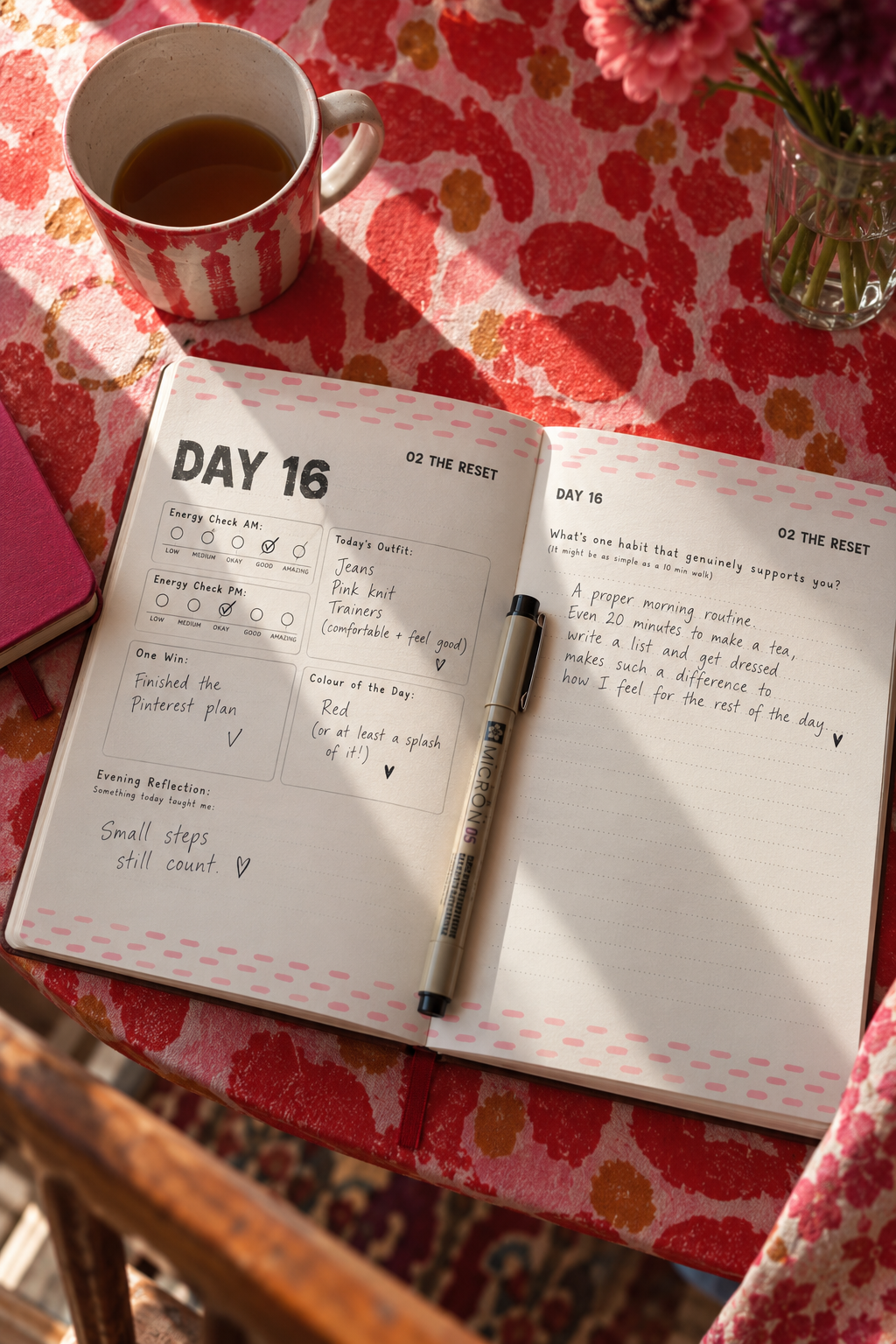
The 60 days in my planner run through four phases, in this order. It is not a coincidence that most people quit journaling somewhere in the first one.
The Wake-Up. Before anything changes, you have to see what is actually happening. Not what you tell people is happening.
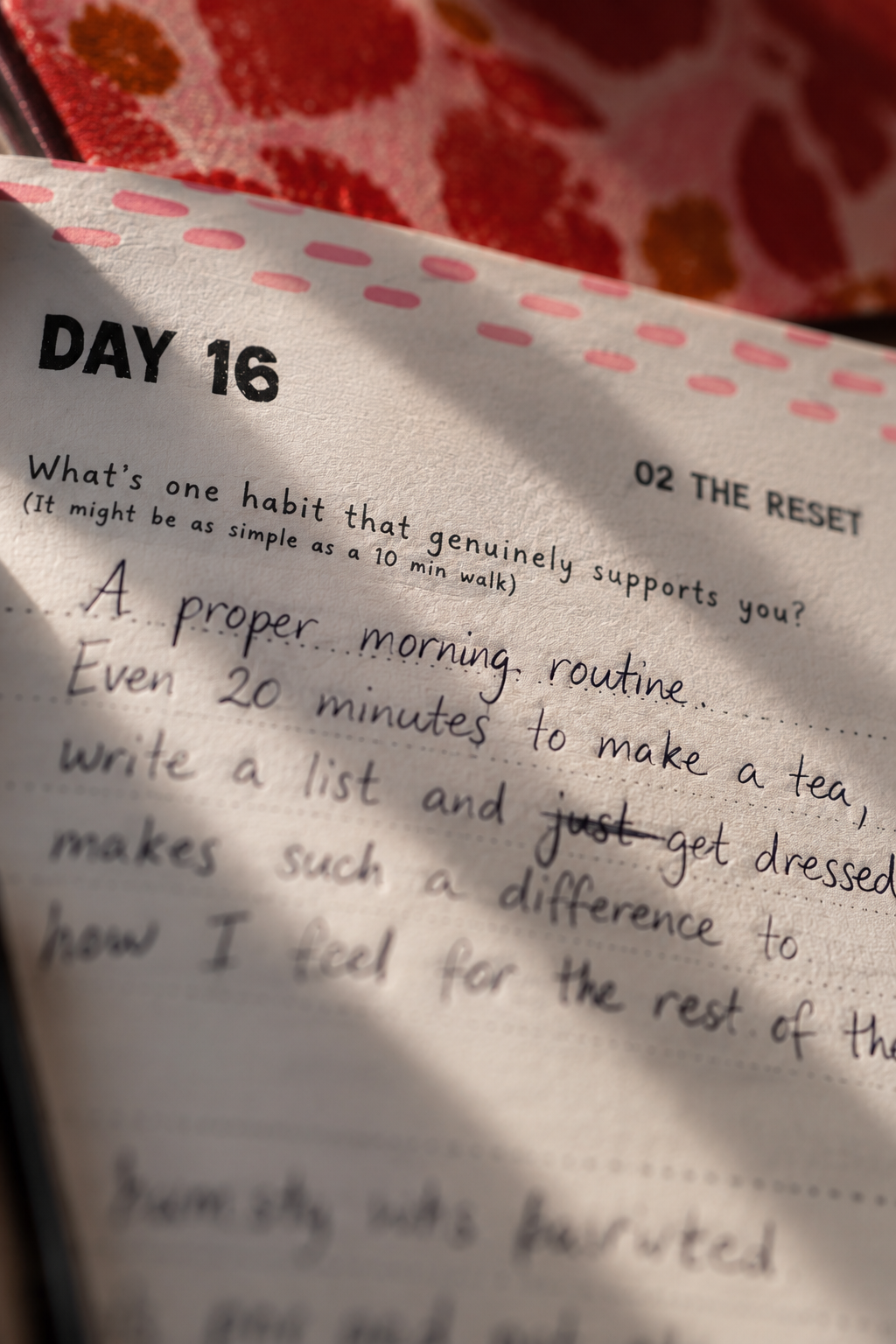
The Reset. Find the habit doing the damage and put one small thing in its way.
The Rebellion. Do the slightly bold thing while it still feels uncomfortable.
The Return. Work out what to hold onto when life gets loud again, because it will.
Everything below is grouped by those four. Start at the top. Do not skip ahead to the Rebellion ones because they sound more fun. They will not land if you have not done the waking up.
Phase one: The Wake-Up
These are for the first fortnight. They are dull on purpose. Dull is the point.
What did I shrink myself for today?
What am I carrying that is not actually mine?
When did I last feel most like myself, and what was I doing?
What colour have I been avoiding, and what do I think it says about me?
Who brings me back to myself, and when did I last see them?
What did I want today, before I talked myself out of it?
The colour one catches people out. Ask a woman what colour she avoids and she will tell you it is because it does not suit her. Ask her what it would mean if she wore it anyway and you get a completely different answer.
Phase two: The Reset
Two weeks in, you have enough material to spot the pattern. Now you go after it.
Where is my energy leaking, and what is the leak?
What am I doing purely because I think I should?
Which boundary of mine wobbles the most, and who is standing on it?
What is one tiny thing I could change tomorrow that would take less effort than not changing it?
What am I still hoping someone else will notice and fix?
What story about myself am I overdue an update on?
Phase three: The Rebellion
This is where it gets uncomfortable, which is how you know it is working.
What is one small, bold thing I could do this week?
What am I no longer willing to apologise for?
Where do I edit myself before I have even opened my mouth?
Where did I take up space today without shrinking afterwards?
What did I say no to, and how did my body feel afterwards?
Be specific with the apology one. "I am done apologising for being me" is too big to act on. "I am done apologising for ordering wine at lunch on a Tuesday" is something you can actually do this week.
Phase four: The Return
The last stretch. Less about change, more about making sure the change survives contact with a normal Thursday.
What reminded me of my strength recently?
What tiny ritual is already holding me up?
What choice today sounded most like me?
What part of this do I want to protect when the diary fills up again?
What would tell me I am starting to drift?
What is a moment recently that made me think: there I am.
That last one is the one that matters. Everything else is scaffolding.
How to actually use these
Pick one, not a set. Six in one sitting is a way of avoiding all of them.
Five minutes, not thirty. Long enough to get past the polite first answer, short enough that you will do it again tomorrow.
Write the version you would delete if someone read it over your shoulder. That is the true one. The first thing you write is usually the presentable one.
Do not read back for at least a fortnight. Too early and it turns into performance. You start writing for the future reader instead of answering the question.
Miss a day and just carry on. The women who finish are not the disciplined ones. They are the ones who do not treat a missed Tuesday as evidence of anything. I built pages into the book for exactly this and called them Lifeline Days, because a planner that punishes you for a bad week ends up in a drawer.
If you want the whole thing laid out for you
That is what 60 Days to Feeling Like Yourself Again is. One prompt a day, one page, sixty days, moving through those four phases so you are not deciding what to work on while you are also trying to work on it. Every page has a Daily Win box too, which sounds like nothing and turns out to be the bit people keep.
It is a paperback, because a notebook you have to open is harder to ignore than an app you can swipe away.
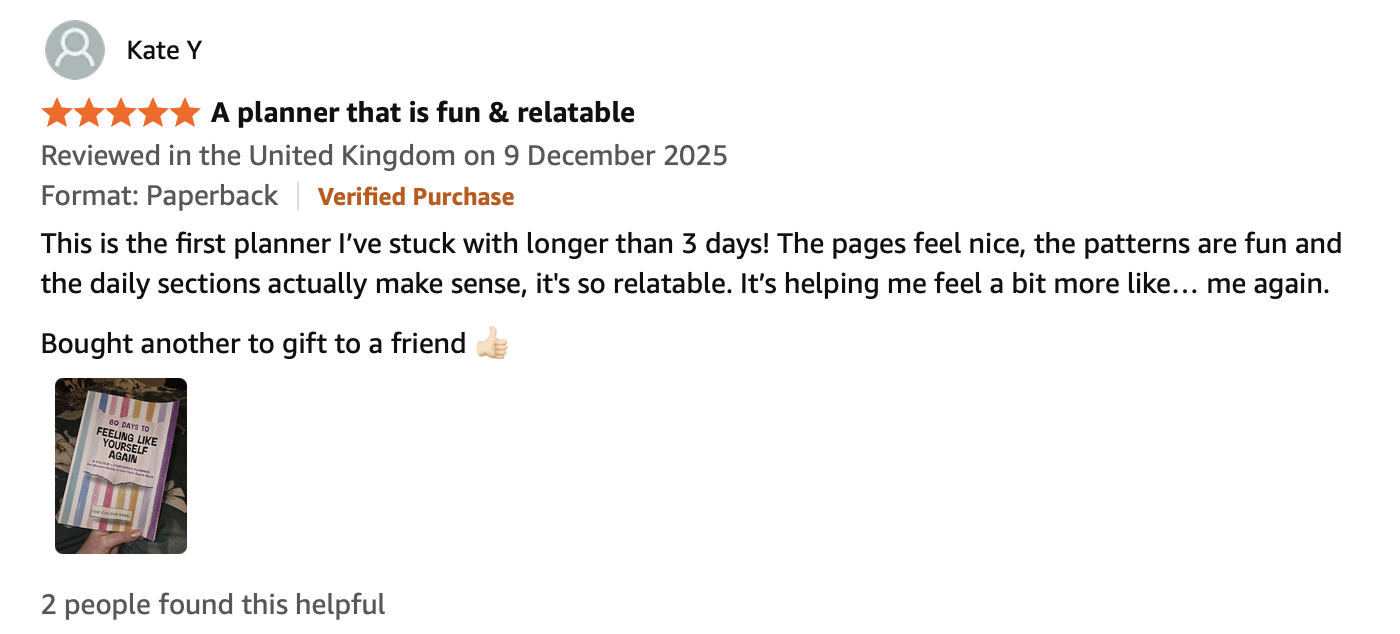
Kate Y, verified purchase on Amazon
And if you have already got it, the daily emails are free and they are the bit that gets people to day sixty. One a day, matched to the page you are on, plus printable versions of every page.
Start with one question. Answer it badly. That is genuinely all it takes.