9 Fashion Rules You Are Allowed To Stop Following
Somewhere along the way, getting dressed stopped being about whether you love something and started being about whether you are still allowed to wear it.
You probably cannot remember when that happened. There was no announcement. Just a slow accumulation of rules, picked up from magazines, from a comment your mother made once, from a woman on television in 2004 explaining what suits a pear shape, from whatever the general mood was about hemlines the year you turned thirty.
Nobody sat you down and taught you these. You absorbed them. And now they run in the background every morning while you stand in front of your wardrobe deciding what is appropriate, which is a word that has done more damage to more wardrobes than any other in the language.
Here is the thing about all of them. Every one of these rules was written by somebody, for a reason, at a particular moment, usually to sell something. None of them descended from anywhere. They are opinions that got repeated until they sounded like physics.
So here are nine of them. Where they came from, why they stuck, and why you can put them down.
Rule one: never wear pink and red together
This is the most-broken rule in fashion and it was never a rule, it was a fashion editor's preference that hardened into law somewhere around 1975.
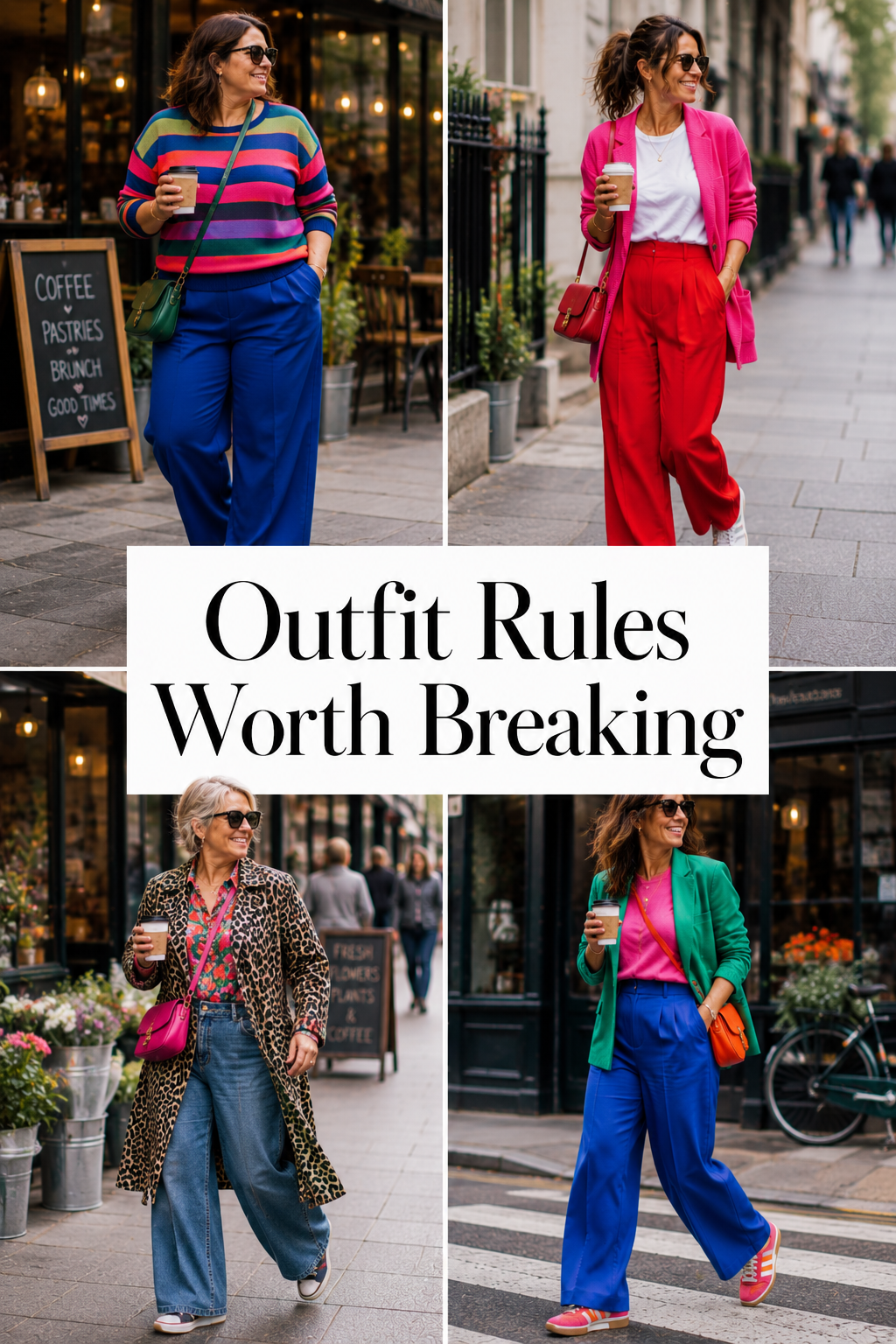
Pink and red is not a clash at all. Pink is red with the volume turned down. You are wearing one colour at two strengths, which is about the most harmonious thing you can do. Every designer knows this, which is why the combination turns up on a runway every other season and gets written about as if it has just been invented.
Wear the pink jumper with the red trousers. Nothing will happen. That is rather the point.
If it still feels like too much on a Monday, put the red on your body and the pink on your mouth. A lipstick counts. It has always counted, and it is the cheapest way in the world to find out whether you can stand the sight of two colours together on you.
Rule two: never mix your prints
The rule says prints must match. That is the error, right there in the instruction.
Prints are not supposed to match. They are supposed to be different enough not to compete, with one thread of connection so the outfit reads as a decision. Change the scale, share one colour, let one print lead. There are four rules that make print mixing work and none of them involve matching anything.
The women who look most interesting are almost always wearing two prints. You have been reading that as talent. It is a technique.
And the rule has a tell. Notice that nobody ever applies it to a room. You would not tell someone her curtains cannot be patterned because the cushions already are. Interiors has always understood that pattern is a layer, not a limit. Wardrobes got handed a different rule and nobody ever asked why.
Rule three: horizontal stripes are unflattering
Let us be precise about what this rule is actually saying. It is saying that a horizontal line makes you look wider, and that looking wider is the worst available outcome, and therefore the stripe is banned.
Sit with the middle bit of that for a second. The rule is not really about stripes.
Almost every rule of this shape is built on the same buried assumption, that the job of your clothes is to make you appear smaller. Not more like you. Smaller. And once you accept that premise, you have handed over every decision you will ever make in a changing room.
I am not going to tell you not to care what you look like. Of course you care. Everyone cares. But there is a difference between clothes that fit you properly and clothes chosen as damage limitation, and most of us were only ever taught the second one.
Wear the stripe. Horizontally. See what happens.
Rule four: you need a neutral to calm it all down
Sometimes you do. A plain surface gives your eye somewhere to rest and it can be the difference between an outfit and a jumble.
But it has become an automatic reflex rather than a decision, and that is the problem. Colour, colour, right, better calm that down. Why? Calm for whom?
Half the time the neutral is not balancing the outfit. It is apologising for it.
Try one week where you do not add the calming layer. Two colours, both allowed to be themselves, nothing sensible in between. You may hate it. You may also find that the version you have been wearing for years was the compromised one.
Rule five: your shoes should match your handbag
This one is genuinely ancient. It comes from a time when a woman owned one good bag and one good pair of shoes, and matching them was a signal that both were expensive. It was about money, not about style, and it stopped being a useful signal about fifty years ago.
Here is the modern version. Your shoes and your bag are two separate opportunities to put a colour into an outfit. Matching them wastes one.
A cobalt bag and a leopard shoe are doing more for you than a matching brown pair ever will. Your handbag does not owe your shoes anything.
There is a politer version of this rule that is just as limiting, and you have probably been following it without noticing. It says the shoes and bag do not have to match each other, but they do have to pick up a colour from your outfit. Same instinct, better manners. It still means every accessory is echoing something that is already there instead of adding something that is not.
Rule six: three colours is too many
Where did the number three come from? Nobody knows. It gets repeated as though it were arithmetic.
If you want a structure rather than a ban, use proportion instead of a headcount. Sixty per cent one colour, thirty per cent a second, ten per cent a third. The sixty is your main event, the thirty is the answer to it, and the ten is the bit that makes people look twice. A bag, a shoe, a lipstick, a sock.
That is a three colour formula that never misses, and it works with four colours too if you shrink the last two.
Rule seven: a statement piece needs everything else plain
The idea being that two interesting things cancel each other out.
They do not. Two interesting things become a style. What actually goes wrong is that both are demanding to be looked at first, which is a hierarchy problem, not an arithmetic one. Decide which one leads and let the other support it. Now you have a statement coat and a statement boot and nobody is confused.
Every woman you have ever described as having great style is wearing at least two statement pieces. Go and look. She is not being careful. She has just decided what the outfit is about.
This rule does the most damage to the things you own and love most. The gorgeous coat, the boots, the enormous earrings, all of them waiting for an occasion where everything else is plain enough to deserve them. So they sit there. A statement piece worn twice a year is not a statement piece, it is an ornament with a hanger.
Rule eight: some colours stop being appropriate at a certain age
Right. This one.
There is an entire industry built on convincing women to become more palatable as they get older. Quieter clothes, safer colours, shorter hair, less of everything. It is sold as elegance. It is dressed up as knowing what suits you now. And it is the single most profitable lie in the business, because a woman who believes she is not allowed things buys endless replacements for what she actually wants.
Colour does not check your birth certificate. What genuinely changes is your colouring, your hair goes lighter or greyer, your skin tone shifts, and the specific version of a colour that suits you moves with it. That is a real and useful thing to know. It is a reason to find your red rather than to give up red.
Everyone can wear red. You have just not found your red yet.
Rule nine: if you are not sure, wear black
This is the one that costs the most, because it looks like sensible advice.
Black is not neutral on most of us by our forties. It drains, it flattens, it puts a shadow under your eyes, and it replaces personality with safety. Sometimes black is sophistication. Quite often it is fear in cardigan form.
But "wear black" persists because it is a default and defaults are useful, so you need a better one rather than nothing.
Here it is. When you are not sure: one colour you know suits you, on the biggest piece. One pattern neutral, which means leopard, stripe, check or spot, on the second piece. One accessory in a colour that has no business being there. Done, in ninety seconds, and infinitely more interesting than the black.
Also, and I say this warmly, "not sure" is not a reason. It is a feeling. It passes.
So which rules are actually worth keeping
This matters, because I am not standing here telling you there are no rules. That would be useless and you would be right not to believe me.
Keep the rules about fit. Clothes that fit properly look better on everybody and that is not a conspiracy, it is a fact about fabric and gravity.
Keep the rules about proportion, the ones about balancing volume, hem lengths against shoes, where a waistline sits. Those are real and they are learnable and they will serve you forever.
Keep anything that makes you feel fantastic. If you love a matching set, wear the matching set. Nobody is confiscating it.
Bin every rule whose only function is to make you smaller, safer or less noticeable. That is the whole test and it takes about four seconds to apply. Ask what this rule is actually for. If the answer is "so nobody looks at me too hard", it can go.
You can usually tell the difference by how the rule sounds in your head. The useful ones sound like information. Hems sit better here. This fabric wants more room. The other kind sounds like a warning, and it usually arrives in somebody else's voice.
You were not born too much. You were trained to be less.
The one rule rebellion
Do not go home and overhaul your wardrobe. That is a project, projects need energy, and you have precisely none spare.
Do this instead. Pick one rule off this list. The one that made you slightly uncomfortable when you read it, because that is the one still running.
Break it this week. Once. Somewhere with low stakes.
Then notice what actually happens, because it is never what you braced for. Nobody says anything. The world does not react. The only thing that changes is that you catch yourself in a shop window and think, oh, there she is.
Nobody is coming to give you permission. That is the bad news and it is also the good news.
Where to start if you have no idea what suits you
Breaking a rule is easier when you know what you are replacing it with. Otherwise you are just swapping one guess for another, and that is exhausting.
The Style Clarity Reset is £27 and it is the shortest route from "I have a wardrobe full of clothes and nothing to wear" to actually knowing what you are doing. It is not a shopping list. It is the thinking underneath, so you stop needing permission from a magazine to get dressed.
If you are not ready to spend anything, take the free style quiz first. Two minutes.
Colourfully Rebellious.