How to Colour Clash: 10 Easy Outfit Formulas to Steal
Most advice about wearing colour is useless in exactly the same way. It shows you a photograph of a woman in head-to-toe fuchsia standing in front of a yellow wall in Marrakesh, and then it says: be brave.
Be brave is not instructions. Be brave is a mood.
What actually stops people is not courage. It is the blank page. Standing in front of a wardrobe at seven in the morning trying to invent an outfit from scratch is hard, and it is hard for everybody, and it gets harder when you are also trying to be adventurous while you do it.
So do not invent anything. Copy a formula. That is what everyone whose outfits you admire is doing, they just have theirs memorised.
I am a qualified colour analyst and these are the ten I hand out most often, because they are the ones that survive contact with a real wardrobe on a real morning.
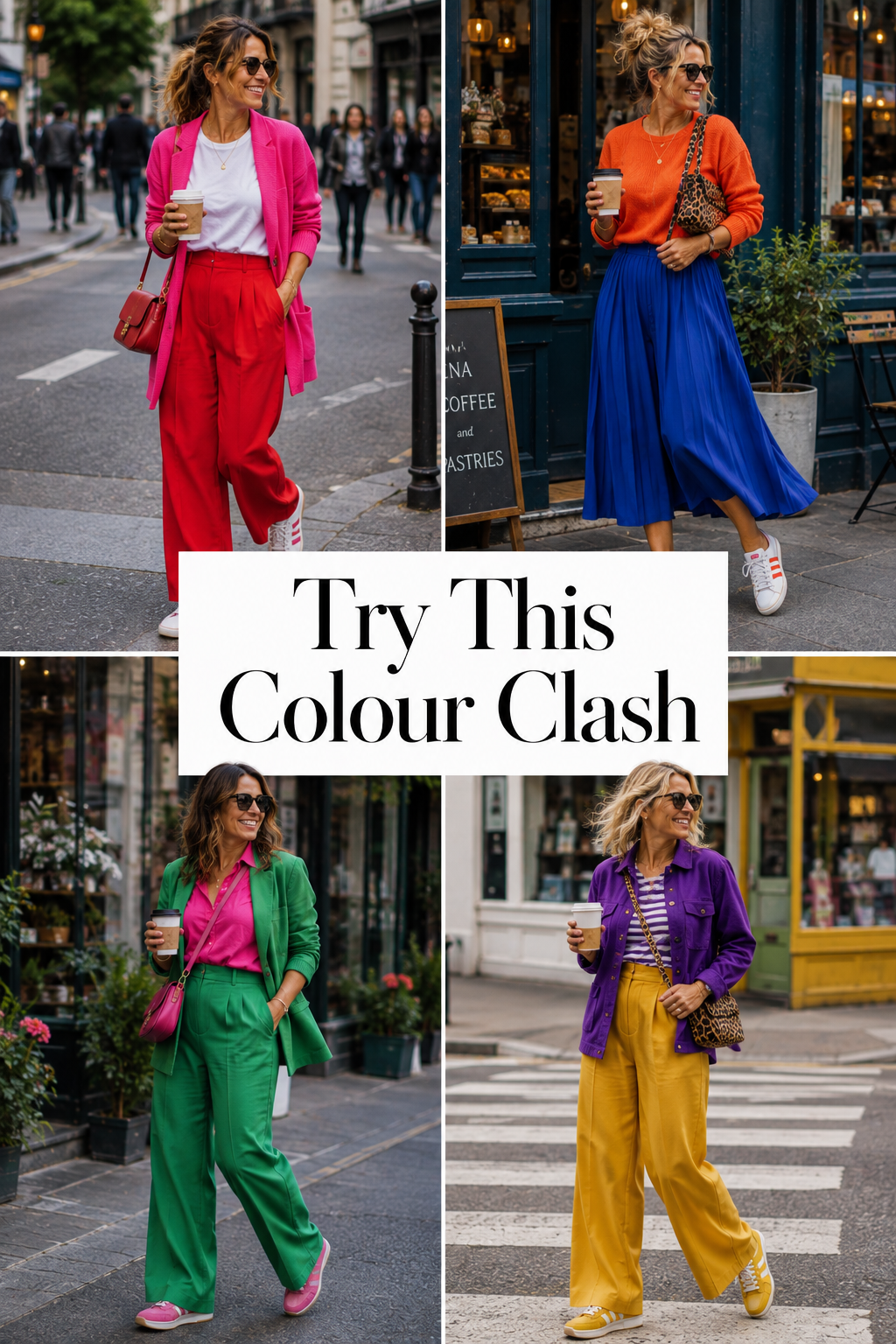
Here are ten of mine, written out in full. Each one comes with an easier version and a bolder one, so you can pitch it at whatever nerve you have available on the day. Some mornings that is not much and there is no need to pretend otherwise.
Steal them exactly.
Matching and clashing are not the same thing
Quick distinction, because the words get used interchangeably and they are not the same.
Matching is colours that were designed to sit comfortably together. Navy and white. Camel and cream. Black and grey. They agree with each other. There is nothing wrong with them and there is also nothing happening.
Clashing is colours with enough tension between them that your eye has to do a small amount of work. Pink against red. Cobalt against orange. It is not a mistake, it is friction, and friction is the entire difference between an outfit that is fine and an outfit somebody remembers.
The word clash sounds like a warning because it was taught to you as one. Reframe it. You are not making an error. You are putting two things next to each other on purpose.
There is a useful test for whether something is clashing or just wrong. Clashing colours hold their ground against each other. Wrong is one colour shouting and one whispering, because then your eye reads the second one as a mistake the first one is exposing. The full version of that argument, and which unexpected colours actually work together, is post one's job.
How much of each colour: the Dip, the Duo and the Clash
Which colours go together is post one's job. Which prints go together is post two's. This is the third thing, and it is the one that decides whether any of it feels doable or terrifying. Not which colours. How much of each.
The Dip. One colour does almost the whole outfit. The second colour turns up small, in a bag, a shoe, an earring, a lipstick. You are dipping a toe. This is where you start and there is no shame in living here for a month.
The Duo. Two colours, both given real space, roughly sixty forty. A coloured top with coloured trousers. This is the one that feels like a leap and is not, because you have already worn both colours, just never at the same volume.
The Clash. Two strong colours at close to equal weight, plus a third accent or a print. This is the full version. It gets photographed. It also takes about four goes before it stops feeling like a costume, which is normal and not a sign that it is not for you.
None of the ten below are tagged Dip, and that is deliberate, because the Dip is not a formula. It is a setting you can put any of them on. Take any outfit here, keep the main colour, and shrink the second one down to a bag or a shoe or a lipstick. That is the Dip version and it exists for every single one.
So start anywhere. Take a Clash and dip it. Move up when the dipped version stops feeling like anything. There is no timetable and nobody is marking this.
One more thing about proportion, because it is the part people get wrong when they finally do try. Reversing the amounts turns one formula into two. Cobalt trousers with an orange knit and an orange dress with a cobalt jacket are the same two colours and they land completely differently, because whichever colour has the most fabric is the one the outfit is about. So if a formula here feels almost right but not quite, do not bin it. Flip it.
10 colour clashing outfit formulas
Formula 1: pink top, red trousers, neutral trainer
Duo. The gateway clash, and the one that surprises people most.
Why it works: you are not clashing two colours at all, you are wearing one colour at two strengths, so there is nothing for your eye to reconcile. That is the whole reason it looks expensive rather than chaotic. The neutral trainer is the thing stopping it tipping into fancy dress, so do not upgrade it yet.
Make it easier: keep the pink pale and the red deep, so the contrast is about depth rather than heat.
Make it Rebel: swap the trainer for a leopard flat and add a red lip.
Formula 2: cobalt trousers, orange knit, leopard bag
Clash. The loud one, and the one worth building towards.
Why it works: cobalt and orange sit opposite each other on the wheel and at opposite ends of the temperature scale, so the tension is at maximum. The leopard bag is doing the structural work here. It bridges both colours without adding a fourth idea, which is what a pattern neutral is for.
Worth saying plainly, because this is the outfit people mean when they say they could never. You could. It is two garments and a bag.
Make it easier: rust instead of orange. Same relationship, lower volume.
Make it Rebel: white boot instead of a flat shoe, and a red lip, because red has no business being there and that is the point.
Formula 3: green suit, pink T-shirt, white trainer
Duo. Smart enough for work, loud enough to be yours.
Why it works: emerald and pink are both saturated, both at full strength, and neither backs down. The white trainer keeps it from reading as an occasion outfit, which is what makes it wearable on a Wednesday.
Make it easier: a green blazer with jeans and the pink tee. Half the commitment, most of the effect.
Make it Rebel: hot pink instead of soft, gold jewellery, and swap the trainer for a metallic loafer.
Formula 4: purple jacket, mustard trousers, printed blouse
Clash. The grown-up one.
Why it works: purple and yellow are opposites, but mustard is a yellow knocked back with brown, so it is not shouting. That lets the purple go deep and dramatic. The printed blouse is the bridge, because a print bridges two colours better than any plain third piece can.
Make it easier: drop the blouse to cream and let the two colours do the work.
Make it Rebel: make the blouse leopard.
Formula 5: turquoise skirt, red knit, pink bag
Clash. Three colours, and somebody told you three colours was too many.
Why it works: turquoise is cool, red is hot, and both are at the same medium-high intensity, so neither dominates. The pink bag is the ten per cent, and it is doing something clever, sitting between the red and the turquoise in temperature so your eye reads all three as one decision.
Make it easier: lose the pink bag, keep the turquoise and red as a Duo.
Make it Rebel: make the bag hot pink rather than dusty, and add a gold shoe.
Formula 6: orange dress, cobalt jacket, metallic shoe
Clash. Formula 2 turned inside out.
Why it works: same pairing, reversed proportions, and it is a completely different outfit. That is worth noticing, because it means every formula here is actually two. The metallic shoe works as a neutral that still has personality, which is exactly what this outfit needs at the bottom.
Make it easier: a rust or terracotta dress and a navy jacket. Same shape, gentler.
Make it Rebel: silver shoe, silver jewellery, and a bag in a third colour entirely.
Formula 7: pink dress, green cardigan, leopard accessory
Duo. The easiest Clash-adjacent outfit on the list.
Why it works: pink and green is a pairing you already accept everywhere except on your own body. Keep both at the same depth, a dusty pink with a sage, or a hot pink with an emerald. The leopard accessory is functioning as a neutral, not as a third colour.
Make it easier: cardigan open over the dress so the green reads as a frame rather than a block.
Make it Rebel: hot pink and emerald, and make the accessory leopard shoes rather than a bag.
Formula 8: yellow trousers, purple knit, denim jacket
Clash. The loudest on the list, calmed down by the most ordinary thing you own.
Why it works: yellow and purple are direct opposites at full strength. Denim is the great British neutral and it takes the edge off without apologising for anything, which is what a sensible neutral layer would do.
Make it easier: mustard trousers instead of true yellow.
Make it Rebel: lose the denim, add a leopard coat.
Formula 9: red skirt, pale blue shirt, orange bag
Clash. The one that looks the most effortless and is not.
Why it works: pale blue is cold and light, red is hot and dense, so the contrast is in both temperature and weight. The orange bag is a sly move, because it is closer to the red than to the blue, so it deepens one side rather than adding a new argument.
Make it easier: swap the orange bag for tan.
Make it Rebel: make the shirt a stripe and the bag pink.
Formula 10: cobalt dress, emerald coat, hot pink accessory
Clash. The full version, and the one to build up to.
Why it works: cobalt and emerald are both jewel tones, both deep, both cold, so they hold together like a pair. Then the hot pink arrives from a completely different temperature and detonates the whole thing. Three colours, all at full strength, no neutral anywhere.
Make it easier: navy instead of cobalt, and a pink scarf rather than a pink bag.
Make it Rebel: gold everything. Shoes, jewellery, the lot.
Raid your wardrobe in ten minutes
You almost certainly own three of these already and have never assembled one.
Set a timer. Ten minutes.
Pick the brightest single thing you own. The one you bought because you loved it and wear about twice a year.
Now hold it against every other colour in your wardrobe. Not outfits, just colour against colour, one at a time, on the bed. Do it fast and do not think about shape or occasion or whether the fabrics go, because that is a different problem for a different day.
Photograph anything that makes you pause. You are not deciding yet, you are collecting.
You are looking for two things. Colours you already own that would make a Duo, and one small thing in a colour you would never have chosen that could be the ten per cent.
That is it. No shopping. Almost everybody finds at least two outfits they already own.
The bit the formulas cannot do for you
Here is the honest limit of everything above.
You now have ten formulas. What you do not have is your version of each colour in them. Emerald is not one colour, it is about forty. So is pink. So is red. Copy a formula in the wrong version of each and you will look in the mirror, decide colour does not suit you, and go back to the safe thing, when what actually happened is that somebody handed you a stranger's green.
That is the difference between copying these and owning them.
The Style Clarity Reset is £27 and it closes that gap. If you have not done anything like this before, the style quiz is free and takes two minutes.
Everyone can wear red. You just have not found your red yet.
Colourfully Rebellious.