Stop Matching Your Clothes: This Is What Makes an Outfit Interesting
Here is an outfit. Pink floral blouse. You look at the print, find the pink, and pick pink trousers. Then a pink bag, because it goes. Then a pink shoe, because it also goes.
Nothing is wrong with it. It is tidy. It matches. You would not be embarrassed to be seen in it and nobody would ever comment.
Now here is the other one. Same pink floral blouse. Cobalt trousers. Leopard bag. Orange trainer.
Something is happening in the second one. It is the same blouse and the same body and it is a completely different woman wearing it.
That difference is not budget and it is not confidence and it is definitely not being born with an eye. It is the difference between matching and styling, and almost nobody explains that they are two separate jobs.
Both outfits took the same amount of time. That is the part worth sitting with. The second one is not more effort, it is a different question asked at the start.
Matching and styling are two different jobs
Matching is a safety procedure. It asks one question. Do these things go?
It is a reasonable question and it has kept you out of trouble for about thirty years. The trouble is that "does it go" has an upper limit, and the limit is fine. You cannot match your way past fine.
Styling asks a different question. Not does it go, but what is this outfit about?
Once you ask that, everything changes, because now you need a lead, a supporting act, and something that makes the whole thing yours. Matching gives you an outfit nobody objects to. Styling gives you an outfit somebody remembers, and those are not the same ambition at all.
You were taught the first one and told the second one was for people with flair. It is not. It is three decisions instead of one.
And there is a reason matching got taught and styling did not. Matching is safe to teach. It has a right answer, it can be printed in a magazine, it cannot embarrass anybody. Styling requires an opinion, and nobody was ever going to hand you one of those in a supplement. So you got the version that keeps you tidy, and the other version got sold back to you later as talent you were born without.
The "just pick a colour out of the print" trap
This is the most repeated piece of styling advice in existence. You have a patterned thing, so pull one colour out of the pattern and wear that.
It works. That is why it survived. It is genuinely useful and I give it to people all the time.
But it is the starting point, not the answer, and somewhere along the way it became your ceiling.
Take one patterned garment and try it three ways.
Safe. A colour picked out of the print. Pink blouse, pink trousers. Correct, calm, finished.
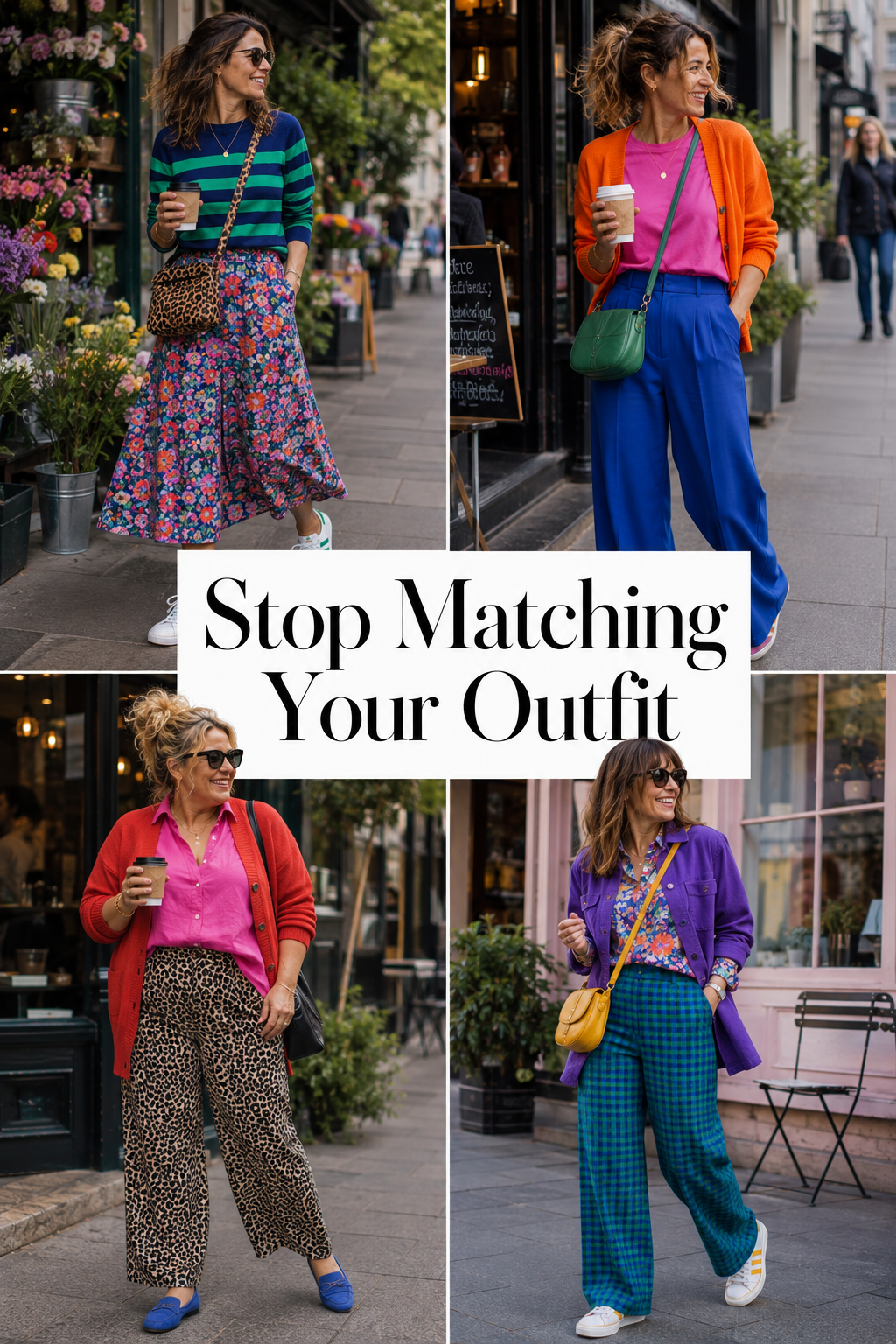
Confident. A colour that is not in the print at all. Pink floral blouse, cobalt trousers. Now the print has something to push against, and you have made a decision rather than followed an instruction.
Rebel. A contrasting colour plus an unexpected print or accessory. Pink floral blouse, cobalt trousers, leopard bag. Three ideas, none of them apologising.
Notice what happens between Safe and Confident. The blouse does not change. The trousers change, and suddenly the print looks like a choice rather than a given. That is because a matched colour makes the print recede into the outfit, and a contrasting one makes the print announce itself. Same garment, two completely different amounts of presence.
Do that with one garment this week and photograph all three. You will not need me to tell you which one you like. What you will need is somebody to tell you that you are allowed to wear it, so here it is: you are allowed to wear it.
Your handbag does not owe your shoes anything
Accessories are where matching does the most damage, because there are so many of them and every single one is an opportunity you can spend or waste.
A bag, a shoe, a scarf, earrings, a belt, a coat, a lipstick. That is seven decisions. If every one of them is echoing a colour that is already in the outfit, you have made seven decisions and added nothing.
So use them properly. An accessory can bring in a third colour that appears nowhere else. It can bring in leopard, which behaves like a neutral for reasons post two goes into properly. It can bring in a metallic, which is a colour pretending to be a neutral and getting away with it. It can bring in a print when the rest of the outfit is plain, and a second print is a technique, not a talent.
Or it can deliberately not repeat anything. That is a choice too, and it is the strongest one on the list.
Two accessories in a colour that appears nowhere else in the outfit is the move worth practising, because repetition is what your brain will reach for automatically. Orange bag, orange earring, everything else cobalt and pink. The orange is now its own thread running through the outfit instead of an echo of something already there, and the whole thing reads as composed rather than coordinated.
Somebody handed you the rule that your bag should match your shoes and you have been carrying it around ever since without ever asking who wrote it. It was about money, not about you, and there is a whole post on where that rule came from and eight others like it.
The one thing that does not belong
Here is the trick, and it is the most useful thing in this entire post.
Build an outfit that works. Properly works. Coordinated, comfortable, the version you would normally leave the house in.
Then add one thing that technically should not be there.
A leopard bag. A red sock. An orange cardigan. A striped shirt under the jumper. A green trainer. A brooch that belonged to somebody's grandmother and matches nothing in the room.
Then look in the mirror and ask one question. Did it ruin it, or did it finish it?
You will be surprised how often the answer is finished. Not always. Sometimes it is genuinely too much and you take it off, and that is fine, that is what the mirror is for. But the hit rate is far higher than your nerves are telling you, and the reason is simple. A perfectly coordinated outfit has no entry point for a person. The odd thing is where you get in.
That is what people mean when they say somebody has style. They mean there is a bit of her in the outfit. It is the bit that does not go.
Start the odd thing small if you need to. A sock. An earring. Something under a coat that only you know is there. It still counts, and it counts for a reason that has nothing to do with anybody else seeing it. You are proving to yourself that you can leave the house with something deliberately unresolved on your body and the day carries on as normal. That is the whole lesson and it is a very cheap one to learn.
Stop buying complete outfits
This one is expensive so it is worth being blunt about.
If every new thing you buy only works with the exact pieces you bought alongside it, you are not building a wardrobe. You are accumulating outfits. And outfits are a terrible investment, because when one piece wears out or stops fitting or you go off it, the whole set dies with it.
You know the shape of this already. The wardrobe that is full and produces nothing. That is not a shopping problem. It is a wardrobe made of about nine sealed units that cannot talk to each other.
The test at the till is one question. What three things I already own does this go with?
If the answer is nothing, you are buying an outfit. If the answer is three or four things you can picture, you are buying a piece, and pieces compound. Every one you add multiplies against everything already in there.
That is the actual difference between a woman with a lot of clothes and a woman with a lot of outfits, and it is not how much either of them spent.
There is a version of this that costs nothing to fix, by the way. Go and find the sealed units you already own. The two-piece you only ever wear as a two-piece. The dress with its own jacket. Split them. Wear the jacket with jeans, wear the skirt with something that has no business being near it. Half the time you will find you have owned four outfits and been wearing two.
The Almost Wrong test
This is the one I would tattoo on the inside of a wardrobe door.
Before you leave the house, look in the mirror and ask: is everything matching a little too perfectly?
If the answer is yes, change one thing.
Not because matching is bad. It is not. Because the slightly unexpected element is where you turn up in your own outfit, and if everything agrees with everything else then technically nobody is in there.
Almost wrong is the target. Not wrong. Almost. That small amount of friction, the bit where your eye catches slightly, is the entire difference between an outfit that is correct and an outfit that is yours.
And here is the part I actually want you to hear. This was never really about clothes. You have spent years making yourself easy to be around. Easy to look at. Easy to agree with, mostly, because disagreeing cost more than it was ever worth. Matching is that same instinct in fabric form, and it is so old you cannot remember learning it.
The one odd thing is you putting your hand up.
Your challenge, tomorrow morning
Get dressed exactly as you normally would. Do not try. Do not plan it tonight.
Then, before you leave, take one predictable choice out and replace it with the option you first thought did not go. The bag you would not normally pick up. The shoe in the wrong colour. The scarf that has nothing to do with anything.
Then look again. Properly, not the quick glance you usually give yourself on the way past.
Ask the question. Did it ruin it, or did it finish it?
Nobody is coming to give you permission for this. That is the bad news and it is also, genuinely, the good news, because it means you do not have to wait.
The shortcut, if you want one
Everything above gets easier when you know which colours are actually yours.
That is not a small thing, it is the whole foundation. If you know your reds, your pinks, your greens, then the odd thing you add is odd on purpose rather than by accident, and you stop testing every decision against a mirror and a bad feeling. You already know the colour works. All you are deciding is whether you fancy it today.
That is what a personal colour analysis is for. Not rules. Not a list of things you are banned from. Your actual palette, so you can stop guessing in changing rooms and start playing.
I am a qualified colour analyst, London College of Style, and I have done this with hundreds of women. The bit that surprises people is that almost nobody leaves with a shorter list of colours. They leave with a longer one.
Online is £127 and in person in Farnham is £247. If you would rather start free, take the style quiz first, it takes two minutes and it will point you in the right direction.
You do not need a new wardrobe. You need permission, and one thing that does not go.
Colourfully Rebellious.